COMPASS

Public resource

Rotator Cuff Rehab & Strength

Restore strength, improve stability and move with confidence. A structured, progressive approach to help you ease shoulder pain, rebuild shoulder function and return to the activities you love.

What is the rotator cuff?

The rotator cuff is a group of four muscles and their tendons that stabilise your shoulder, control its movement and protect the joint.

  • Supraspinatus
  • Infraspinatus
  • Teres minor
  • Subscapularis

Common signs

  • Shoulder pain, especially with overhead movement
  • Weakness or a feeling of instability
  • Clicking or catching
  • Pain at night or when lying on that side

Key rehab principles

  • Pain is your guide. Stay in a pain-free to mild range (0–3 out of 10).
  • Quality over quantity. Slow, controlled reps count for more than big numbers.
  • Gradual, consistent progress. Small steps, repeated often.
  • Control before load. Build strong control before adding weight or resistance.
  • Patience today, strength tomorrow. Tendons adapt slowly.

Daily habits that help

  • Good posture
  • Sleep well
  • Move often
  • Manage stress
  • Strengthen gently
  • Fuel and hydrate

Warm-up: shoulder circles

Forward circles and backward circles: start with small circles and gradually make them bigger.

Keep your shoulders relaxed, move smoothly and stay pain-free.

Reps 10–15 circles each way

Sets 2

Use Daily, to improve mobility and ease stiffness

Rehab stages: step by step

Work through the stages in order. The timeframes are a guide: move on when you are ready, not by the calendar. If an exercise increases your pain, go back a step.

Stage 1: Protect & calm (0–2 weeks)

Goals: Reduce pain, restore gentle range and activate the supporting muscles.

1. Pendulum swings
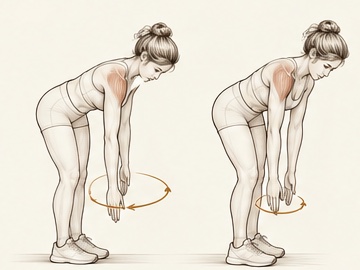
Two drawings of a person leaning forward with one arm hanging and making small circles

Lean forward with your arm hanging loosely and let it swing in small circles, then change direction.

Time 30–60 seconds each direction

Sets 2–3

2. Scapular sets

Gently draw your shoulder blades back and down, hold briefly, then relax. Avoid shrugging.

Reps 10–15

Sets 2–3

3. Isometric holds

Press your hand gently into a wall without letting your shoulder move, in a few different directions.

Hold 5–10 seconds

Reps 5 in each direction

Stage 2: Restore mobility & activation (2–4 weeks)

Goals: Improve mobility, wake up the rotator cuff and improve control.

1. Side-lying external rotation (no weight)
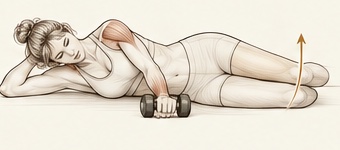
A person lying on their side rotating the forearm upward with the elbow tucked in

Lie on your side with your elbow bent and tucked against your ribs. Rotate your forearm upward, then lower with control.

Reps 10–15

Sets 2–3

2. Band row
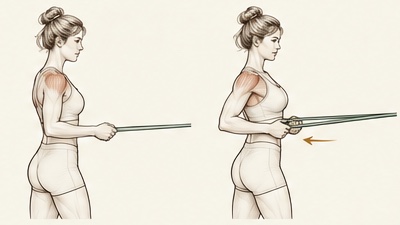
Two drawings of a person pulling a resistance band back toward the waist

Hold a resistance band and pull your hands back toward your waist, drawing your shoulder blades together.

Reps 12–15

Sets 2–3

3. Wall slides
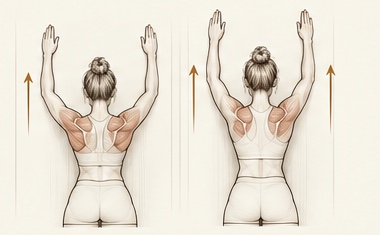
Back view of a person sliding both arms up a wall

With your hands or forearms on a wall, slide your arms up and down within a comfortable range. Keep your shoulders relaxed.

Reps 10–15

Sets 2–3

Stage 3: Build strength & stability (4–8 weeks)

Goals: Build strength, endurance and shoulder stability.

1. External rotation (band)
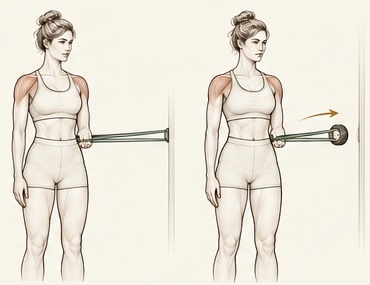
A person standing and rotating the forearm outward against a resistance band

Keep your elbow bent and tucked at your side. Rotate your forearm outward against the band, then return slowly.

Reps 12–15

Sets 2–3

2. Internal rotation (band)

Keep your elbow bent and tucked at your side. Rotate your forearm inward against the band, then return slowly.

Reps 12–15

Sets 2–3

3. Scaption raise

Raise your arms in a V shape, about 30–45° in front of your body, thumbs up, then lower with control.

Reps 12–15

Sets 2–3

Stage 4: Advanced strength & control (8–12 weeks)

Goals: Improve dynamic control, power and overhead strength.

1. Prone Y, T, W
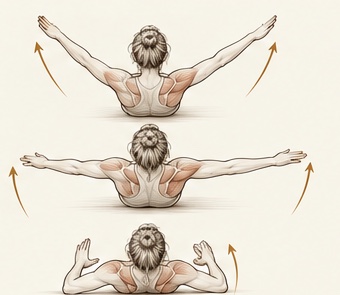
Back view of a person lying face down lifting the arms into Y, T and W positions

Lie face down and lift your arms into a Y, then a T, then a W shape, keeping your neck relaxed.

Reps 8–12 each position

Sets 2–3

2. Face pulls
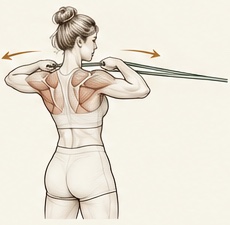
Back view of a person pulling a resistance band toward the face

Pull a band toward your face, leading with your elbows and squeezing your shoulder blades together.

Reps 12–15

Sets 2–3

3. Landmine press
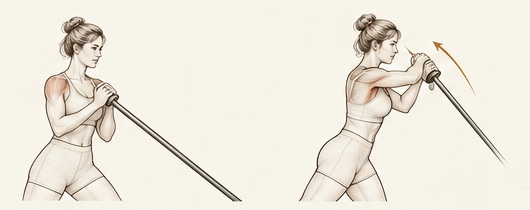
Two drawings of a person pressing the end of an angled bar up and forward

Press the end of an angled bar up and forward in a smooth arc, keeping your trunk steady.

Reps 10–12

Sets 2–3

Stage 5: Return to activity (12+ weeks)

Goals: Return to training, sport and performance.

1. Overhead press
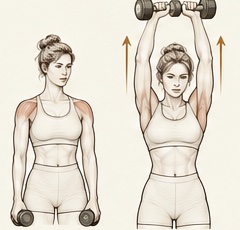
A person lifting a pair of dumbbells from the sides to overhead

Press light weights overhead with control, keeping your ribs down and your neck relaxed.

Reps 10–12 each

Sets 2–3

2. Medicine ball wall toss
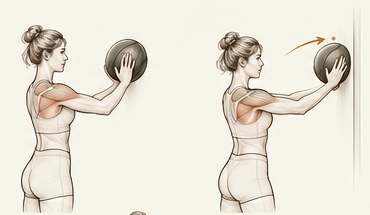
Two drawings of a person tossing a medicine ball against a wall

Toss a medicine ball against a wall and catch it with control, keeping your shoulders steady.

Reps 10–15

Sets 2–3

3. Push-up plus
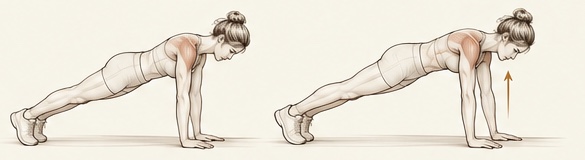
Two side-view drawings of a person in a plank pushing the floor away

From a plank, lower slightly, then push the floor away so your shoulder blades spread apart at the top.

Reps 10–15

Sets 2–3

Ready to move on?

Before progressing to the next stage, check that you have:

  • Minimal to no pain
  • Full pain-free range
  • Good control
  • Strength symmetry
  • Confidence in movement

Extra rotator cuff focus exercises

Add these once the earlier stages feel comfortable, or as your chiropractor suggests.

1. Horizontal abduction (band)
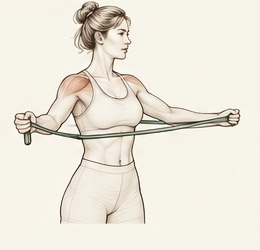
A person holding a band across the body and pulling the hands apart

Hold a band with your arms in front of you at shoulder height and pull your hands apart.

Reps 12–15

Sets 2–3

2. 90/90 external rotation
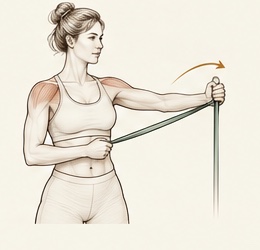
A person with the elbow out to the side rotating the forearm upward against a band

With your elbow out to the side and bent to 90°, rotate your forearm upward against the band.

Reps 10–12

Sets 2–3

3. D2 flexion (band)
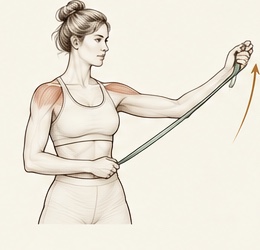
A person moving a band diagonally up and across the body

Start with your hand by the opposite hip and move diagonally up and across, finishing above your shoulder.

Reps 12–15

Sets 2–3

When can I return to training?

  • Pain-free daily activities
  • Full range of motion
  • About 90% or more of your strength compared with the other side
  • No pain with sport-specific movements
  • Confidence and control under load

Tip Returning to sport is a process, not an event.

Training modifications

  • Avoid heavy overhead lifting early on.
  • Use lighter loads with perfect form.
  • Increase volume and intensity gradually.
  • Include rest days and recovery.

Daily shoulder care routine

Warm up 5–10 minutes

Mobility 5 minutes

Strength 10–20 minutes

Move often Throughout the day

Recover well Sleep, food and rest

When to seek help

If pain persists, worsens or limits your daily function, get assessed by a healthcare professional.

General educational information from the practice — not personalised advice or a prescription. If anything is painful, stop. Book an appointment for guidance specific to you.

Ask Compass

Public resource

Rotator Cuff Rehab & Strength

Restore strength, improve stability and move with confidence. A structured, progressive approach to help you ease shoulder pain, rebuild shoulder function and return to the activities you love.

What is the rotator cuff?

The rotator cuff is a group of four muscles and their tendons that stabilise your shoulder, control its movement and protect the joint.

  • Supraspinatus
  • Infraspinatus
  • Teres minor
  • Subscapularis

Common signs

  • Shoulder pain, especially with overhead movement
  • Weakness or a feeling of instability
  • Clicking or catching
  • Pain at night or when lying on that side

Key rehab principles

  • Pain is your guide. Stay in a pain-free to mild range (0–3 out of 10).
  • Quality over quantity. Slow, controlled reps count for more than big numbers.
  • Gradual, consistent progress. Small steps, repeated often.
  • Control before load. Build strong control before adding weight or resistance.
  • Patience today, strength tomorrow. Tendons adapt slowly.

Daily habits that help

  • Good posture
  • Sleep well
  • Move often
  • Manage stress
  • Strengthen gently
  • Fuel and hydrate

Warm-up: shoulder circles

Forward circles and backward circles: start with small circles and gradually make them bigger.

Keep your shoulders relaxed, move smoothly and stay pain-free.

Reps 10–15 circles each way

Sets 2

Use Daily, to improve mobility and ease stiffness

Rehab stages: step by step

Work through the stages in order. The timeframes are a guide: move on when you are ready, not by the calendar. If an exercise increases your pain, go back a step.

Stage 1: Protect & calm (0–2 weeks)

Goals: Reduce pain, restore gentle range and activate the supporting muscles.

1. Pendulum swings

Two drawings of a person leaning forward with one arm hanging and making small circles

Lean forward with your arm hanging loosely and let it swing in small circles, then change direction.

Time 30–60 seconds each direction

Sets 2–3

2. Scapular sets

Gently draw your shoulder blades back and down, hold briefly, then relax. Avoid shrugging.

Reps 10–15

Sets 2–3

3. Isometric holds

Press your hand gently into a wall without letting your shoulder move, in a few different directions.

Hold 5–10 seconds

Reps 5 in each direction

Stage 2: Restore mobility & activation (2–4 weeks)

Goals: Improve mobility, wake up the rotator cuff and improve control.

1. Side-lying external rotation (no weight)

A person lying on their side rotating the forearm upward with the elbow tucked in

Lie on your side with your elbow bent and tucked against your ribs. Rotate your forearm upward, then lower with control.

Reps 10–15

Sets 2–3

2. Band row

Two drawings of a person pulling a resistance band back toward the waist

Hold a resistance band and pull your hands back toward your waist, drawing your shoulder blades together.

Reps 12–15

Sets 2–3

3. Wall slides

Back view of a person sliding both arms up a wall

With your hands or forearms on a wall, slide your arms up and down within a comfortable range. Keep your shoulders relaxed.

Reps 10–15

Sets 2–3

Stage 3: Build strength & stability (4–8 weeks)

Goals: Build strength, endurance and shoulder stability.

1. External rotation (band)

A person standing and rotating the forearm outward against a resistance band

Keep your elbow bent and tucked at your side. Rotate your forearm outward against the band, then return slowly.

Reps 12–15

Sets 2–3

2. Internal rotation (band)

Keep your elbow bent and tucked at your side. Rotate your forearm inward against the band, then return slowly.

Reps 12–15

Sets 2–3

3. Scaption raise

Raise your arms in a V shape, about 30–45° in front of your body, thumbs up, then lower with control.

Reps 12–15

Sets 2–3

Stage 4: Advanced strength & control (8–12 weeks)

Goals: Improve dynamic control, power and overhead strength.

1. Prone Y, T, W

Back view of a person lying face down lifting the arms into Y, T and W positions

Lie face down and lift your arms into a Y, then a T, then a W shape, keeping your neck relaxed.

Reps 8–12 each position

Sets 2–3

2. Face pulls

Back view of a person pulling a resistance band toward the face

Pull a band toward your face, leading with your elbows and squeezing your shoulder blades together.

Reps 12–15

Sets 2–3

3. Landmine press

Two drawings of a person pressing the end of an angled bar up and forward

Press the end of an angled bar up and forward in a smooth arc, keeping your trunk steady.

Reps 10–12

Sets 2–3

Stage 5: Return to activity (12+ weeks)

Goals: Return to training, sport and performance.

1. Overhead press

A person lifting a pair of dumbbells from the sides to overhead

Press light weights overhead with control, keeping your ribs down and your neck relaxed.

Reps 10–12 each

Sets 2–3

2. Medicine ball wall toss

Two drawings of a person tossing a medicine ball against a wall

Toss a medicine ball against a wall and catch it with control, keeping your shoulders steady.

Reps 10–15

Sets 2–3

3. Push-up plus

Two side-view drawings of a person in a plank pushing the floor away

From a plank, lower slightly, then push the floor away so your shoulder blades spread apart at the top.

Reps 10–15

Sets 2–3

Ready to move on?

Before progressing to the next stage, check that you have:

  • Minimal to no pain
  • Full pain-free range
  • Good control
  • Strength symmetry
  • Confidence in movement

Extra rotator cuff focus exercises

Add these once the earlier stages feel comfortable, or as your chiropractor suggests.

1. Horizontal abduction (band)

A person holding a band across the body and pulling the hands apart

Hold a band with your arms in front of you at shoulder height and pull your hands apart.

Reps 12–15

Sets 2–3

2. 90/90 external rotation

A person with the elbow out to the side rotating the forearm upward against a band

With your elbow out to the side and bent to 90°, rotate your forearm upward against the band.

Reps 10–12

Sets 2–3

3. D2 flexion (band)

A person moving a band diagonally up and across the body

Start with your hand by the opposite hip and move diagonally up and across, finishing above your shoulder.

Reps 12–15

Sets 2–3

When can I return to training?

  • Pain-free daily activities
  • Full range of motion
  • About 90% or more of your strength compared with the other side
  • No pain with sport-specific movements
  • Confidence and control under load

Tip Returning to sport is a process, not an event.

Training modifications

  • Avoid heavy overhead lifting early on.
  • Use lighter loads with perfect form.
  • Increase volume and intensity gradually.
  • Include rest days and recovery.

Daily shoulder care routine

Warm up 5–10 minutes

Mobility 5 minutes

Strength 10–20 minutes

Move often Throughout the day

Recover well Sleep, food and rest

When to seek help

If pain persists, worsens or limits your daily function, get assessed by a healthcare professional.

General educational information from the practice — not personalised advice or a prescription. If anything is painful, stop. Book an appointment for guidance specific to you.