COMPASS

Public resource

Neck & Upper Back: Rolled Towel Exercises

Two simple rolled towel exercises for the stiffness and aching that come from long hours at a desk.

Rolled towel for neck pain
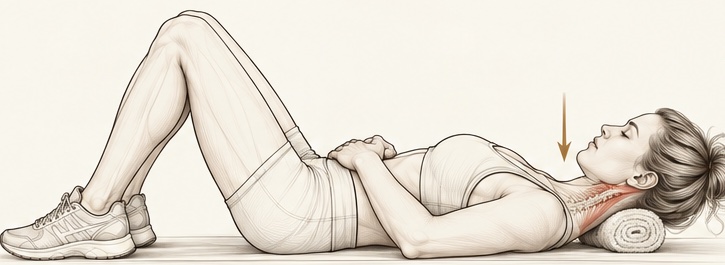
A person lying on their back with a small rolled towel under the neck, knees bent

A lot of neck pain, mostly postural, can be linked to poor sitting at work. Seen from behind, the natural curve of the neck is concave, and is known as the cervical lordosis. You may start the day sitting up straight and tall, but sitting posture tends to slip as the day goes on.

Many desk workers end up poking their chins forward towards the screen. This “poked-chin” posture increases bending in the lower part of the neck and extension at the base of the skull. It can disrupt the normal curve and add to stiffness and pain at the base of the skull and aching around the shoulders, because the body has to work harder to hold the head on the shoulders.

How to do it

  1. Roll up a towel and lie on your back with the towel behind your neck.
  2. Roll it thick enough that your head sits level with your upper back, but not so thick that it props your head up like a pillow.
  3. Stay here for 10–15 minutes.

What you should feel At the right thickness you should feel well supported around the neck and able to relax your neck muscles completely, giving them a rest. Over time, this may help to gently restore the neck’s natural curve.

Rolled towel for upper back pain
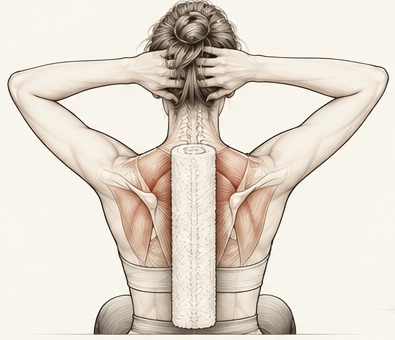
Back view of a person with hands behind the head and a rolled towel running vertically down the spine

For the same reasons, desk workers may suffer pain and discomfort in the upper back and shoulder area. Any posture with prolonged forward bending can cause pain between the shoulder blades and tightness or stiffness in the muscles around them.

How to do it

  1. Lie on your back with a rolled towel placed vertically down your spine.
  2. Let your head, neck and arms drop back as far as is comfortable. Together they act as a lever that helps to bend the spine back the other way.
  3. For more reach, do this on a bench so your arms can drop further down past your body.
  4. To add intensity, stretch your arms out wide.
  5. Stay for no more than about two minutes.
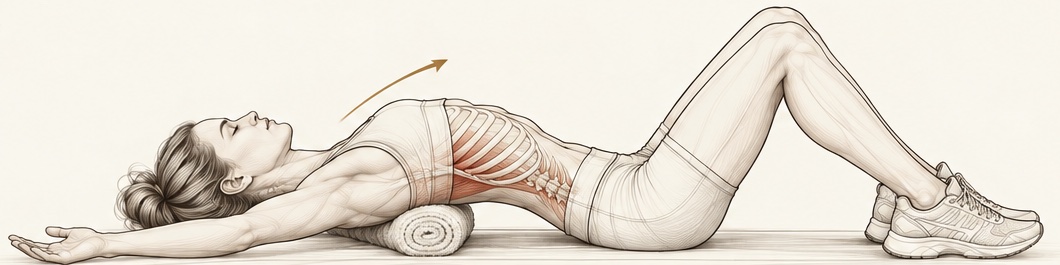
A person lying back over a rolled towel placed across the upper back, arms stretched out wide, knees bent

Why a towel A towel is softer than a foam roller. A roller’s diameter is often too large and lifts you too far from the ground, which puts undue stress on your neck.

How it feels This exercise is quite intense, and most people can only tolerate about two minutes.

Good to know

  • Stop if you feel sharp pain, dizziness, or pins and needles or numbness in your arms or hands.
  • For the lower back, see the 90/90 (astronaut) position in Protecting Your Back.

Exercises adapted from The Physical Therapy Centre (thephysicaltherapycentre.com.au).

General educational information from the practice — not personalised advice or a prescription. If anything is painful, stop. Book an appointment for guidance specific to you.

Ask Compass

Public resource

Neck & Upper Back:
Rolled Towel Exercises

Two simple rolled towel exercises for the stiffness and aching that come from long hours at a desk.

Rolled towel for neck pain

A person lying on their back with a small rolled towel under the neck, knees bent

A lot of neck pain, mostly postural, can be linked to poor sitting at work. Seen from behind, the natural curve of the neck is concave, and is known as the cervical lordosis. You may start the day sitting up straight and tall, but sitting posture tends to slip as the day goes on.

Many desk workers end up poking their chins forward towards the screen. This “poked-chin” posture increases bending in the lower part of the neck and extension at the base of the skull. It can disrupt the normal curve and add to stiffness and pain at the base of the skull and aching around the shoulders, because the body has to work harder to hold the head on the shoulders.

How to do it

  1. Roll up a towel and lie on your back with the towel behind your neck.
  2. Roll it thick enough that your head sits level with your upper back, but not so thick that it props your head up like a pillow.
  3. Stay here for 10–15 minutes.

What you should feel At the right thickness you should feel well supported around the neck and able to relax your neck muscles completely, giving them a rest. Over time, this may help to gently restore the neck’s natural curve.

Rolled towel for upper back pain

Back view of a person with hands behind the head and a rolled towel running vertically down the spine

For the same reasons, desk workers may suffer pain and discomfort in the upper back and shoulder area. Any posture with prolonged forward bending can cause pain between the shoulder blades and tightness or stiffness in the muscles around them.

How to do it

  1. Lie on your back with a rolled towel placed vertically down your spine.
  2. Let your head, neck and arms drop back as far as is comfortable. Together they act as a lever that helps to bend the spine back the other way.
  3. For more reach, do this on a bench so your arms can drop further down past your body.
  4. To add intensity, stretch your arms out wide.
  5. Stay for no more than about two minutes.
A person lying back over a rolled towel placed across the upper back, arms stretched out wide, knees bent

Why a towel A towel is softer than a foam roller. A roller’s diameter is often too large and lifts you too far from the ground, which puts undue stress on your neck.

How it feels This exercise is quite intense, and most people can only tolerate about two minutes.

Good to know

  • Stop if you feel sharp pain, dizziness, or pins and needles or numbness in your arms or hands.
  • For the lower back, see the 90/90 (astronaut) position in Protecting Your Back.

Exercises adapted from The Physical Therapy Centre (thephysicaltherapycentre.com.au).

General educational information from the practice — not personalised advice or a prescription. If anything is painful, stop. Book an appointment for guidance specific to you.