Public resource
Flat Feet: Flexible vs Rigid
A flat foot means the inner arch is low or absent. Most flat feet are flexible, common and painless. A rigid flat foot is different, and is worth having assessed. Knowing which type you have helps decide what, if anything, to do.
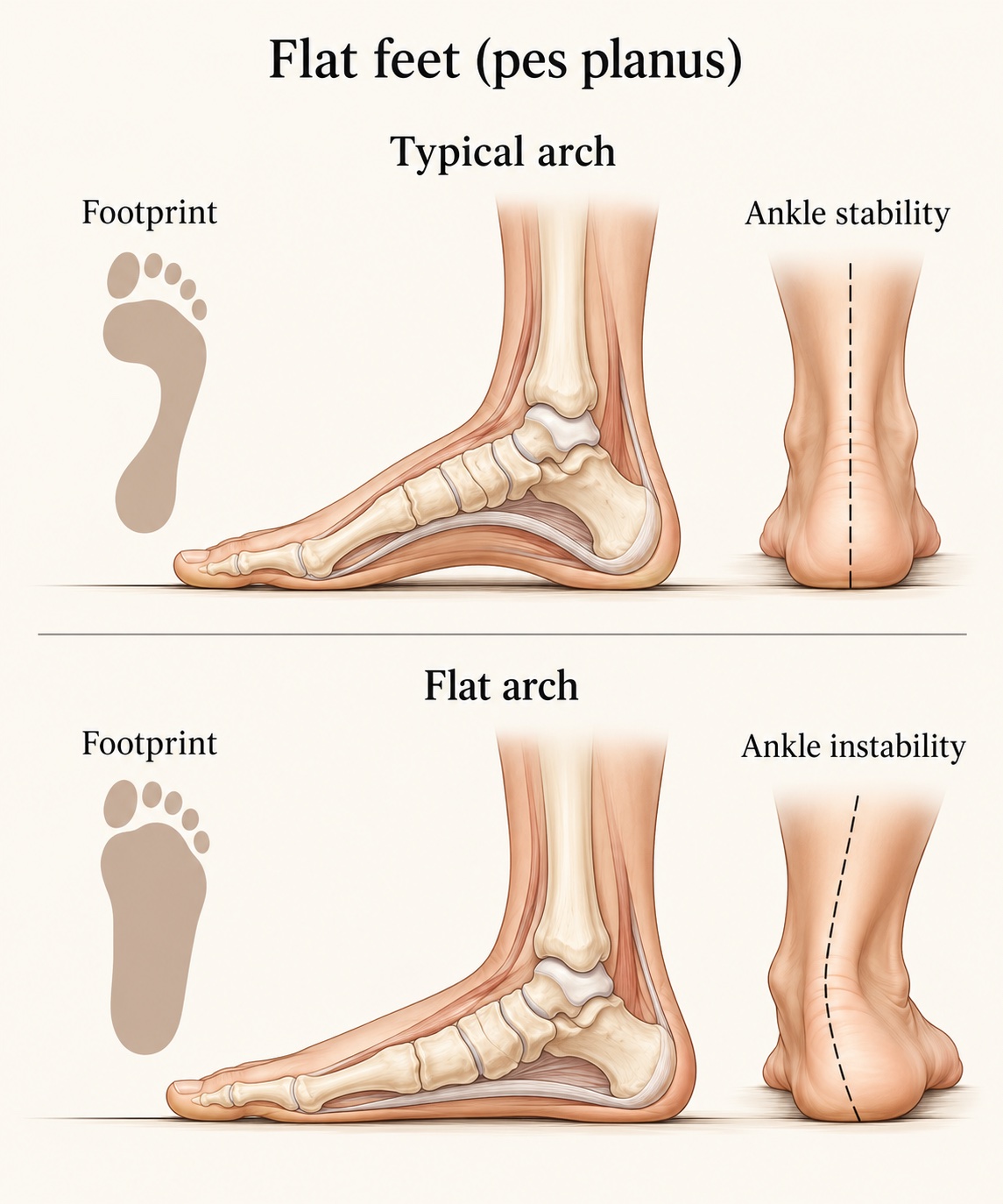
Two types of flat foot
- Flexible flat foot. The arch is visible when you sit or rise onto your toes, and flattens when you stand. The foot moves normally. This is the most common type.
- Rigid flat foot. The arch stays flat whether you sit, stand or rise onto your toes, and the foot feels stiff. It is less common and often has a structural cause.
A simple check at home
This is a guide only and does not replace an assessment.
- Stand barefoot and look at your arch from the side and from behind.
- Sit down and look again. Does an arch appear when your foot is unloaded?
- Stand and rise onto your toes, or lift your big toe while keeping the ball of the foot down. Does an arch appear?
- Compare both feet and note any stiffness, pain or one foot that looks different.
An arch that appears in sitting or on tiptoe suggests a flexible foot. An arch that stays flat in every position suggests a rigid foot, and should be looked at by a professional.
Flexible flat feet
- Often cause no pain and need no treatment
- May go with tight calves, weak foot and hip muscles, or hypermobility
- Can contribute to foot, ankle, knee or hip aches in some people, especially with a lot of standing or running
- Respond well to strengthening, calf mobility, good footwear and, where symptoms need it, supports
Rigid flat feet
- The foot has limited movement, and often feels stiff, tired or painful
- Can be linked to joints in the back of the foot that have joined together (such as a tarsal coalition), arthritis, injury or inherited differences
- Often shows up as repeated ankle sprains, pain at the outer or inner foot, or difficulty walking on uneven ground
- Usually needs a proper assessment and sometimes imaging. Do not force stretches into a stiff, painful foot.
When a flat foot should be checked
- Pain, swelling or tiredness in the arch or inner ankle
- An arch that has dropped or changed in adulthood, especially on one side
- A stiff, painful flat foot in a child or teenager
- Repeated ankle sprains or difficulty walking on uneven ground
- A foot that looks different from the other and does not change when you stand on your toes
Five exercises for flexible flat feet
These suit flexible flat feet. If your foot is rigid or painful, check with your chiropractor before starting.
1. Short foot
Sit or stand with your foot flat. Without curling your toes, gently draw the ball of the foot towards the heel so the arch lifts. Hold, then relax.
Hold 5 seconds
Reps 10
Progression Do it standing, then on one leg.
2. Big toe lift and press
Keep the ball of the foot down and lift only your big toe, then press it down while lifting the other four toes.
Reps 10 each way
Sets 2
3. Heel raises with an arch lift
Rise onto your toes, keeping your weight over the big toe side of the foot rather than rolling outwards. Lower slowly.
Reps 10–15
Sets 2–3
Progression Move to one leg.
4. Single-leg balance
Stand on one leg with your arch lifted and your knee pointing over your second toe.
Time 30 seconds
Sets 3 each leg
Progression Close your eyes, or stand on a cushion.
5. Calf stretch
Stretch the calf with the knee straight, then bent, with your heel down.
Hold 30 seconds
Reps 3 each position
Footwear and supports
- Choose shoes that fit well, have a firm heel and bend only at the ball of the foot
- Some people feel better with an arch support or orthotic, which is best chosen after an assessment
- Vary your shoes and spend some time barefoot on soft surfaces if it is comfortable
- Replace worn-out shoes
Daily habits that help
- Build up standing, walking and running gradually
- Keep calves, hips and glutes strong and mobile
- Do your foot exercises a few times a week
- Maintain a comfortable body weight and stay active
Red flags: get checked promptly
- Sudden pain or swelling along the inner ankle or arch
- A stiff foot that is painful or locks
- Numbness, pins and needles, or colour change in the foot
- A flat foot in a child that is painful, stiff or limits activity
- Pain after a fall or injury
References
This guide draws on the published sources below. They are listed for further reading and do not replace an assessment.
- Mosca VS. Flexible flatfoot in children and adolescents. J Child Orthop. 2010;4(2):107–121. Source
- Pita-Fernandez S, Gonzalez-Martin C, Alonso-Tajes F, et al. Flat foot in a random population and its impact on quality of life and functionality. J Clin Diagn Res. 2017;11(4):LC22–LC27. Source
- Jung DY, Koh EK, Kwon OY. Effect of foot orthoses and short-foot exercise on the cross-sectional area of the abductor hallucis muscle in subjects with pes planus: a randomized controlled trial. J Back Musculoskelet Rehabil. 2011;24(4):225–231. Source
Related
General educational information from the practice — not personalised advice or a prescription. If anything is painful, stop. Book an appointment for guidance specific to you.